

This article examines the strengths, limitations, and practical use cases of edge, cloud, and hybrid AI architectures in video telematics.
TL;DR — WanWay uses a hybrid operating architecture: the H18P-3CH runs ADAS and DMS inference locally for network-independent alerts, while IOPGPS supports fleet-level monitoring and evidence review. In an illustrative 1 Mbps video policy, uploading 60 minutes of event footage instead of 24 hours of continuous video reduces transmitted data from 10.8 GB to 0.45 GB per day—a 95.8% reduction. Actual data use depends on camera count, bitrate, operating time and upload policy.
An AI dashcam does more than record the road. It may detect lane departure, unsafe following distance, fatigue, distraction, phone use or other safety-related events. But one architectural question determines how quickly and reliably those detections can become useful: where does the AI inference happen?
In an edge-AI dashcam, the model runs inside the vehicle, close to the cameras and sensors. In a cloud-AI system, video or selected frames are transmitted to remote servers for analysis. A hybrid system combines both: the vehicle handles immediate detection, while the cloud supports review, fleet-wide analysis, model governance and long-term learning.
There is no universally superior answer. Edge AI is usually stronger when a warning must happen immediately or when mobile coverage is uncertain. Cloud AI is usually stronger when the task needs greater computing resources, centralized data or cross-fleet context. The most practical architecture for commercial fleets is often hybrid—but only when the division of work is deliberate.
This article explains the trade-offs without treating “edge” or “cloud” as a marketing label.
What Does “AI Dashcam” Actually Mean?
Traditional dashcams capture video for later review. AI dashcams add machine perception: software examines frames and sensor data, classifies patterns and triggers an event, warning or workflow.
The camera facing the road may support advanced driver-assistance functions such as forward-collision or lane-departure warnings. A driver-facing camera may support a driver monitoring system (DMS) that looks for signs associated with fatigue or distraction. Other inputs—GNSS position, speed, acceleration, braking and time—can help describe the event.
This does not make the dashcam an autonomous driving system. It is still an assistance and monitoring tool. The driver remains responsible for the vehicle, and the fleet remains responsible for its safety policies, escalation rules and human review. NHTSA’s description of driver-assistance technologies makes the same distinction: assistance features support the driver; they do not remove the driver’s responsibility.
The system must therefore perform two different jobs:
· react quickly enough to support the driver at the moment of risk; and
· create reliable evidence and context for fleet managers after the event.
Those jobs do not always belong in the same computing location.
Edge AI: Intelligence Inside the Vehicle
In this article, edge AI means that inference runs on the in-vehicle device itself. This is different from telecom multi-access edge computing, where servers sit near a mobile network. Both reduce distance from the data source, but an on-device dashcam can continue operating even when the vehicle has no usable uplink.
The normal sequence is straightforward: cameras capture frames; the local AI processor runs the model; the device identifies an event; and the device can issue an audible or visual warning. It may then store a clip locally and upload metadata or evidence when the network is available.
The defining advantage is not simply speed. It is local operational independence. If the required model, configuration and sensors are already on the device, a temporary cellular outage does not have to stop the first-stage detection.
That makes edge AI a natural fit for time-sensitive functions such as:
· fatigue or distraction warnings intended for the driver;
· forward-collision and lane-departure alerts;
· event-triggered recording;
· selecting which clips should be retained or uploaded; and
· basic event classification when the vehicle is outside coverage.
However, the edge device has finite processor performance, memory, storage, electrical power and thermal capacity. A model that performs well in a data center may be too large or power-hungry for an in-vehicle terminal. Developers may need to compress, quantize or simplify the model, which can affect performance if validation is weak.
Cloud AI: Intelligence in a Remote Data Center
Cloud AI sends video, frames, features or event data to remote computing infrastructure. The cloud can use larger models, combine information from many vehicles and update analytical services centrally.
That architecture is well suited to work that is not required within fractions of a second:
· fleet-wide risk scoring;
· reviewing repeated patterns across routes, drivers or vehicle groups;
· searching and classifying stored video;
· combining dashcam events with maintenance, dispatch or claims data;
· centralized model evaluation; and
· retrospective investigation.
Cloud computing also makes it easier to allocate substantial processing power when demand changes. A fleet can run more complex analysis without replacing every vehicle’s AI processor.
But a cloud-only design turns connectivity into part of the inference path. Video must be captured, encoded, transmitted, received and processed before a result can return. Mobile networks add variable latency and may disappear in tunnels, rural areas, underground parking or cross-border roaming conditions. A cloud alert that arrives after the critical moment may still be useful as evidence, but it is less useful as an immediate driver warning.
The Hybrid Model: Divide the Work by Urgency
A hybrid design does not mean that every task runs twice. It means assigning each task to the location that best matches its operational requirement.
A practical division can look like this:
1. The in-vehicle device detects an event and warns the driver locally.
2. The device stores a short pre-event and post-event clip with timestamp, location and sensor context.
3. The device uploads the event package when bandwidth and policy allow.
4. The platform presents the evidence to an authorized fleet user.
5. Cloud services aggregate events, produce reports and support model-performance review.
The FMCSA Onboard Monitoring System Field Operational Test reflects this broader workflow: onboard monitoring can combine video snippets, vehicle-performance measures and real-time driver feedback. The useful system is not merely a camera or a model. It is the connection between detection, feedback, evidence and fleet action.
1. Latency: When Does the Decision Become Useful?
For real-time warnings, end-to-end latency matters more than the model’s isolated benchmark speed.
Edge inference can begin as soon as frames reach the local processor. The path is short and usually predictable. Cloud inference adds encoding, uplink scheduling, mobile-network transit, server processing and a return channel. Even when average latency looks acceptable, jitter and temporary loss can make it unpredictable.
This does not mean every edge system is fast. A weak processor, overloaded device, poor model optimization or high-resolution multi-camera workload can still produce delay. Likewise, a well-engineered cloud service on a strong network can return results quickly. The correct question is therefore:
What is the measured end-to-end response time under the vehicle’s real operating conditions—not only under laboratory Wi-Fi?
For a driver-facing warning, the answer should include camera capture, model inference, event logic and local alert output. For a fleet notification, it should also include cellular transmission and platform processing.
2. Connectivity: What Happens Outside Coverage?
Edge AI can continue first-stage detection without a live cellular connection. That is valuable for long-haul fleets, mines, ports, tunnels and regions with uneven 4G coverage.
Offline capability still needs careful definition. The device may detect and record an event locally, but it cannot deliver the evidence to a remote manager until connectivity returns. Storage limits, overwrite rules and upload priorities determine whether the event survives a long outage.
Cloud AI depends more directly on the uplink. A system that continuously streams video for remote inference may degrade sharply when bandwidth falls. A system that uploads occasional frames or short clips may be more resilient, but the result is no longer truly continuous cloud analysis.
Buyers should ask three separate questions:
· Can the device detect the event offline?
· Can it warn the driver offline?
· How does it preserve and later upload evidence?
“Works offline” should never be accepted without these distinctions.
3. Bandwidth and Data Cost: Continuous Video Changes the Economics
Video is much heavier than GPS telemetry. The cost difference becomes clear with a simple calculation.
If one video stream averages 1 megabit per second, continuous transmission for 24 hours equals approximately:
1 Mbps × 86,400 seconds ÷ 8 = 10.8 GB per day
At 2 Mbps, the result is approximately 21.6 GB per day. A three-camera system can generate far more, depending on resolution, frame rate, codec, scene complexity and whether all channels transmit continuously.
These are mathematical examples, not WanWay product consumption figures. Real data use depends on configuration and operating time.
Edge event selection can reduce the need to send raw continuous video because the device can upload metadata and relevant clips instead. But aggressive filtering creates another risk: if the local model fails to recognize an event, the cloud may never receive the omitted footage. Good deployment policy therefore balances data cost with evidence retention—for example, local rolling storage plus prioritized event uploads.
4. Privacy and Data Governance: Less Upload Is Not the Whole Answer
Driver-facing video can identify a person, reveal behavior and expose location or working patterns. Road-facing video may capture pedestrians, license plates and private locations. These data require governance, not just storage capacity.
The European Data Protection Board’s connected-vehicle guidelines explain that connected-vehicle processing can involve personal data and therefore trigger data-protection obligations. The GDPR includes data minimization and data protection by design and by default.
Edge AI can support minimization by keeping most raw video on the device and uploading only defined events. It may also reduce exposure during transmission. Yet edge storage is not automatically private. A stolen device, weak access control, unencrypted card or excessive local retention can create its own risk.
Cloud systems can provide centralized access control, logging, retention enforcement and backup, but they also concentrate data and may move it across jurisdictions. Fleet operators should define:
· which cameras record and when;
· whether audio is captured;
· what triggers upload;
· who may view live or recorded video;
· how long local and cloud copies are retained;
· whether drivers are informed; and
· how access and deletion requests are handled.
Architecture can support privacy, but policy and implementation determine it.
5. Compute Capacity: Bigger Models Do Not Guarantee Better Decisions
Cloud infrastructure can host larger models and process high-resolution data from many sources. Edge hardware must operate within the vehicle’s power, temperature, cost and space constraints.
It is tempting to conclude that cloud AI must therefore be more accurate. That conclusion is unsafe. Accuracy depends on training data, sensor placement, image quality, calibration, threshold selection and the conditions represented in validation. A large model trained on the wrong environment can still fail. A compact model designed and tested for a specific in-cabin task can perform better in that task.
The NIST AI Risk Management Framework emphasizes validity, reliability, safety and ongoing monitoring. For dashcams, testing should reflect actual drivers, camera positions, lighting, weather, road markings, clothing, eyewear and vehicle vibration.
NHTSA research also shows why context matters. Its 2024 report on advanced impaired-driving prevention technology notes the growing use of camera-based driver monitoring while test methods continue to develop. An AI label is not a substitute for a clearly defined use case and measurable performance criteria.
6. False Positives and False Negatives: Both Have Operational Costs
A false positive may generate an unnecessary warning or wrongly flag a driver. Repeated false alerts can produce alarm fatigue and reduce trust. A false negative may miss a genuine safety event and create a more serious risk.
Edge versus cloud does not decide this trade-off by itself. Thresholds, sensor fusion and review workflows matter more.
Local accelerometer data, GNSS speed and time can help add context to video. The cloud can compare patterns across trips and allow human reviewers to correct labels. A hybrid workflow can therefore use the edge for immediate caution and the platform for evidence-based coaching.
Fleet policy should avoid treating every AI event as proof of misconduct. A driver may brake harshly to avoid a pedestrian. Looking away briefly may be necessary to check a mirror. Video and context should support fair review, not automatic punishment.
7. Model Updates and Lifecycle Management
Cloud models can be updated centrally, which simplifies version rollout. Edge models require firmware or model-package distribution to many devices. That makes over-the-air update capability, signing, rollback and compatibility important.
Centralized updates are not automatically low-risk. A defective cloud model can affect an entire fleet at once. Edge rollout can be slower, but staged deployment can limit the impact. In either architecture, operators should know:
· which model version is active;
· when it changed;
· what validation supports the change;
· whether thresholds are configurable;
· how rollback works; and
· whether event definitions remain consistent across devices.
NIST’s AI RMF Playbook recommends defining performance metrics, documenting acceptable limits and assessing systems before and after deployment. Those practices are especially important when an AI output can influence driver coaching, insurance evidence or disciplinary decisions.
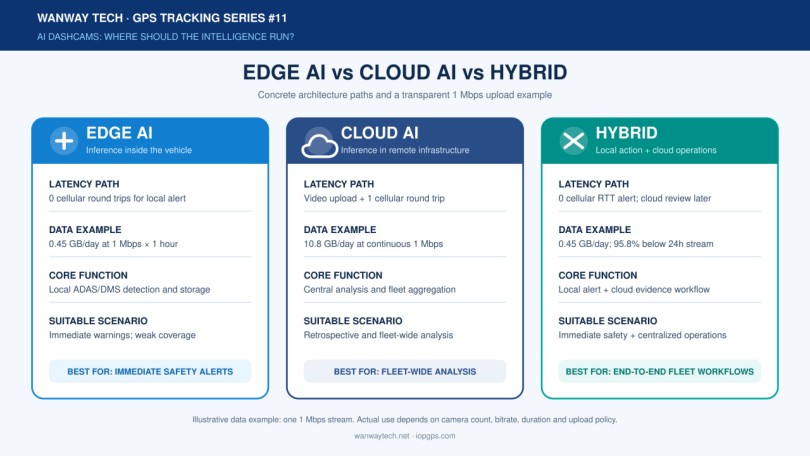
Figure 1. Conceptual comparison of edge AI, cloud AI and a hybrid architecture. Actual performance depends on hardware, model, network, video settings and deployment policy.

When Edge AI Is Usually the Better Fit
Edge AI is generally the stronger starting point when:
· the driver needs an immediate warning;
· vehicles frequently operate with unreliable coverage;
· continuous video upload would be too expensive;
· the organization wants to minimize raw-video transmission;
· event-triggered local recording is sufficient for most workflows; or
· system behavior must remain predictable across roaming networks.
The trade-off is that the in-vehicle hardware must be capable of running the intended models for the product’s service life. Procurement should consider not only today’s model, but also thermal performance, storage, power management and update support.
When Cloud AI Is Usually the Better Fit
Cloud AI is generally stronger when:
· analysis can happen after the event;
· the task benefits from a large or frequently changing model;
· many vehicles must be compared centrally;
· the fleet already uploads the necessary video under an approved policy;
· the organization needs search, trend analysis or cross-system correlation; or
· central governance is more important than offline operation.
Cloud AI can also re-analyze historical footage with a newer model—if the relevant video was retained and the organization has a lawful, transparent basis for doing so.
Why Hybrid Is Often the Practical Fleet Architecture
For commercial fleets, the best answer is often not “edge or cloud” but “which decision belongs where?”
Immediate safety logic belongs close to the vehicle. Fleet-wide learning, evidence review and operational analytics usually belong on the platform. The interface between them should be explicit: event type, timestamp, location, confidence, clip duration, upload priority and retention policy.
A hybrid design also supports graceful degradation. If the network disappears, the device can keep detecting and storing. When the network returns, the platform can receive prioritized evidence. If the cloud service is unavailable, local alerts do not have to stop.
However, hybrid systems are more complex to manage. Device and cloud versions must remain compatible. Duplicate event logic can cause inconsistency. Fleet operators need a clear source of truth for event definitions and model versions.
Questions to Ask Before Choosing an AI Dashcam
Do not begin with the number of AI features printed on a brochure. Begin with the operational decision you need the system to support.
Ask the supplier:
1. Which detections run locally, and which require the cloud?
2. Can local alerts continue without cellular coverage?
3. Which camera channel and sensor inputs support each event?
4. What video is stored locally, and what is uploaded?
5. What is the expected data usage under the proposed configuration?
6. How are model and firmware versions updated and audited?
7. How can authorized users review or correct an AI event?
8. What tests cover night driving, sunglasses, road vibration and different camera positions?
9. What happens when storage is full or the network is unavailable for several days?
10. Which privacy, retention and access-control settings are available?
The answers should be specific to the actual hardware, firmware, camera configuration and platform plan being purchased.
Common AI Dashcam Misconceptions
“Cloud AI is always more accurate.”
Cloud resources may support larger models, but accuracy depends on data, calibration, sensors, thresholds and validation—not computing location alone.
“Edge AI never needs the internet.”
Local detection may work offline, but remote evidence, fleet notifications, updates and centralized reporting still require connectivity.
“Uploading only events solves every privacy issue.”
Event clips can still contain personal data. Access, purpose, retention, security and transparency remain essential.
“More alerts mean a safer fleet.”
Poorly tuned alerts can create fatigue and distrust. Safety improvement depends on relevant events, fair review, coaching and measurable follow-up.
Engineering Perspective
“For an in-vehicle safety alert, the first decision should not depend on whether the vehicle has a stable uplink. The cloud is valuable for fleet-level review, but immediate detection belongs close to the camera.”
— Chris Zhu, Senior Hardware Engineer, WanWay Tech
This statement describes an engineering principle, not a promise that every function works identically in every vehicle. Camera installation, calibration, firmware, lighting and configuration still determine real-world performance.
Frequently Asked Questions
Q: Which is better for my fleet: edge AI or cloud AI?
A: Choose edge AI when immediate alerts, offline operation and controlled video upload are priorities. Choose cloud AI for centralized, compute-intensive analysis. Many commercial fleets benefit from a hybrid workflow: local alerts plus platform-level evidence review and analytics.
Q: Can an AI dashcam still work without a network connection?
A: Yes, if inference and alert logic run locally. An edge-AI dashcam can continue detecting supported events, warning the driver and storing evidence without 4G. Remote viewing, platform notifications and evidence upload resume when connectivity returns.
Q: How can fleets balance privacy protection with safety monitoring?
A: Define a specific safety purpose, restrict access, set retention limits and upload only the evidence needed for review. Local rolling storage plus event-driven upload can reduce raw-video transmission, but legal requirements still vary by jurisdiction.
Q: How much mobile data does an AI dashcam use?
A: It depends on resolution, frame rate, codec, number of cameras, streaming time and event policy. A continuous 1 Mbps stream is about 10.8 GB per day; event-based upload can be much lower.
Q: Does cloud AI provide better accuracy than edge AI?
A: Not automatically. Cloud infrastructure can run larger models, but accuracy depends on training data, camera quality, installation, calibration, thresholds and real-world validation. Compare measured performance for the target use case.
WanWay’s Local-AI Approach
WanWay’s AI dashcam design uses local AI processing for in-vehicle detection. This aligns with applications where immediate ADAS or DMS alerts should not depend on a continuous uplink. The cloud platform then supports the operational layer: evidence access, remote monitoring, trajectory review, alarms and fleet management.
The H18P-3CH is a 4G ADAS + DMS dashcam supporting up to three camera channels: one 1080p channel and two 720p channels. Confirmed capabilities include local ADAS and DMS functions, up to 512 GB TF-card storage, 9–32 V vehicle power input, intelligent power management, acceleration, deceleration, sharp-turn and collision alarms, real-time positioning and trajectory playback.
With the IOPGPS platform, authorized users can manage devices and customers, view positions, review trajectories and alarms, and use available integration capabilities. Exact AI events, camera package, upload behavior, storage policy, data plan and platform functions should be confirmed for the selected hardware and project configuration.
This is not an argument that local AI replaces the cloud. It is a deliberate separation: the device handles time-sensitive detection; the platform handles visibility, evidence and fleet operations.
Key Takeaways
· Edge AI is strongest for immediate alerts, offline resilience and selective video upload.
· Cloud AI is strongest for centralized analysis, larger models and fleet-wide context.
· Hybrid architecture works best when responsibilities, evidence flows and model governance are clearly defined.
Next Step
Before selecting an AI dashcam, define which decisions must happen inside the vehicle, which can wait for the cloud and what evidence the fleet actually needs.
Explore the H18P-3CH and other video-telematics solutions at wanwaytech.net, or visit iopgps.com to learn about the fleet-management platform and request a project demonstration.
EEAT: Research and Technical Review
This article was written by the WanWay Tech IoT Market Research Team and technically reviewed by Chris Zhu, Senior Hardware Engineer, WanWay Tech. It is based on confirmed H18P-3CH product documentation, IOPGPS platform training materials and the public technical sources listed below.
The evaluation framework follows the risk-management principles in the NIST AI Risk Management Framework, including validity, reliability, safety and ongoing monitoring. The privacy discussion references the GDPR and European Data Protection Board guidance. These references do not by themselves certify a product or deployment as compliant; legal and technical validation must be completed for each project and jurisdiction.
WanWay provides project-specific presales and after-sales technical support. Support scope and service hours depend on the applicable quotation or service agreement.
References
1. ETSI — Multi-access Edge Computing (MEC)
2. ETSI GS MEC 002 — MEC Requirements
3. FMCSA — Onboard Monitoring System Field Operational Test
4. FMCSA — Driver Distraction: Eye Glance Analysis and Conversation Workload
5. NHTSA — Driver Assistance Technologies
6. NHTSA — Advanced Impaired Driving Prevention Technology, 2024 Report to Congress
7. NIST — Artificial Intelligence Risk Management Framework 1.0
10. EUR-Lex — General Data Protection Regulation, consolidated text
Author
WanWay Tech IoT Market Research Team
This article provides a technical and operational overview, not legal advice. Product capabilities and platform services depend on the selected model, firmware, accessories, configuration, subscription and target market.
TL;DR — WanWay uses a hybrid operating architecture: the H18P-3CH runs ADAS and DMS inference locally for network-independent alerts, while IOPGPS supports fleet-level monitoring and evidence review. In an illustrative 1 Mbps video policy, uploading 60 minutes of event footage instead of 24 hours of continuous video reduces transmitted data from 10.8 GB to 0.45 GB per day—a 95.8% reduction. Actual data use depends on camera count, bitrate, operating time and upload policy.
An AI dashcam does more than record the road. It may detect lane departure, unsafe following distance, fatigue, distraction, phone use or other safety-related events. But one architectural question determines how quickly and reliably those detections can become useful: where does the AI inference happen?
In an edge-AI dashcam, the model runs inside the vehicle, close to the cameras and sensors. In a cloud-AI system, video or selected frames are transmitted to remote servers for analysis. A hybrid system combines both: the vehicle handles immediate detection, while the cloud supports review, fleet-wide analysis, model governance and long-term learning.
There is no universally superior answer. Edge AI is usually stronger when a warning must happen immediately or when mobile coverage is uncertain. Cloud AI is usually stronger when the task needs greater computing resources, centralized data or cross-fleet context. The most practical architecture for commercial fleets is often hybrid—but only when the division of work is deliberate.
This article explains the trade-offs without treating “edge” or “cloud” as a marketing label.
What Does “AI Dashcam” Actually Mean?
Traditional dashcams capture video for later review. AI dashcams add machine perception: software examines frames and sensor data, classifies patterns and triggers an event, warning or workflow.
The camera facing the road may support advanced driver-assistance functions such as forward-collision or lane-departure warnings. A driver-facing camera may support a driver monitoring system (DMS) that looks for signs associated with fatigue or distraction. Other inputs—GNSS position, speed, acceleration, braking and time—can help describe the event.
This does not make the dashcam an autonomous driving system. It is still an assistance and monitoring tool. The driver remains responsible for the vehicle, and the fleet remains responsible for its safety policies, escalation rules and human review. NHTSA’s description of driver-assistance technologies makes the same distinction: assistance features support the driver; they do not remove the driver’s responsibility.
The system must therefore perform two different jobs:
· react quickly enough to support the driver at the moment of risk; and
· create reliable evidence and context for fleet managers after the event.
Those jobs do not always belong in the same computing location.
Edge AI: Intelligence Inside the Vehicle
In this article, edge AI means that inference runs on the in-vehicle device itself. This is different from telecom multi-access edge computing, where servers sit near a mobile network. Both reduce distance from the data source, but an on-device dashcam can continue operating even when the vehicle has no usable uplink.
The normal sequence is straightforward: cameras capture frames; the local AI processor runs the model; the device identifies an event; and the device can issue an audible or visual warning. It may then store a clip locally and upload metadata or evidence when the network is available.
The defining advantage is not simply speed. It is local operational independence. If the required model, configuration and sensors are already on the device, a temporary cellular outage does not have to stop the first-stage detection.
That makes edge AI a natural fit for time-sensitive functions such as:
· fatigue or distraction warnings intended for the driver;
· forward-collision and lane-departure alerts;
· event-triggered recording;
· selecting which clips should be retained or uploaded; and
· basic event classification when the vehicle is outside coverage.
However, the edge device has finite processor performance, memory, storage, electrical power and thermal capacity. A model that performs well in a data center may be too large or power-hungry for an in-vehicle terminal. Developers may need to compress, quantize or simplify the model, which can affect performance if validation is weak.
Cloud AI: Intelligence in a Remote Data Center
Cloud AI sends video, frames, features or event data to remote computing infrastructure. The cloud can use larger models, combine information from many vehicles and update analytical services centrally.
That architecture is well suited to work that is not required within fractions of a second:
· fleet-wide risk scoring;
· reviewing repeated patterns across routes, drivers or vehicle groups;
· searching and classifying stored video;
· combining dashcam events with maintenance, dispatch or claims data;
· centralized model evaluation; and
· retrospective investigation.
Cloud computing also makes it easier to allocate substantial processing power when demand changes. A fleet can run more complex analysis without replacing every vehicle’s AI processor.
But a cloud-only design turns connectivity into part of the inference path. Video must be captured, encoded, transmitted, received and processed before a result can return. Mobile networks add variable latency and may disappear in tunnels, rural areas, underground parking or cross-border roaming conditions. A cloud alert that arrives after the critical moment may still be useful as evidence, but it is less useful as an immediate driver warning.
The Hybrid Model: Divide the Work by Urgency
A hybrid design does not mean that every task runs twice. It means assigning each task to the location that best matches its operational requirement.
A practical division can look like this:
1. The in-vehicle device detects an event and warns the driver locally.
2. The device stores a short pre-event and post-event clip with timestamp, location and sensor context.
3. The device uploads the event package when bandwidth and policy allow.
4. The platform presents the evidence to an authorized fleet user.
5. Cloud services aggregate events, produce reports and support model-performance review.
The FMCSA Onboard Monitoring System Field Operational Test reflects this broader workflow: onboard monitoring can combine video snippets, vehicle-performance measures and real-time driver feedback. The useful system is not merely a camera or a model. It is the connection between detection, feedback, evidence and fleet action.
1. Latency: When Does the Decision Become Useful?
For real-time warnings, end-to-end latency matters more than the model’s isolated benchmark speed.
Edge inference can begin as soon as frames reach the local processor. The path is short and usually predictable. Cloud inference adds encoding, uplink scheduling, mobile-network transit, server processing and a return channel. Even when average latency looks acceptable, jitter and temporary loss can make it unpredictable.
This does not mean every edge system is fast. A weak processor, overloaded device, poor model optimization or high-resolution multi-camera workload can still produce delay. Likewise, a well-engineered cloud service on a strong network can return results quickly. The correct question is therefore:
What is the measured end-to-end response time under the vehicle’s real operating conditions—not only under laboratory Wi-Fi?
For a driver-facing warning, the answer should include camera capture, model inference, event logic and local alert output. For a fleet notification, it should also include cellular transmission and platform processing.
2. Connectivity: What Happens Outside Coverage?
Edge AI can continue first-stage detection without a live cellular connection. That is valuable for long-haul fleets, mines, ports, tunnels and regions with uneven 4G coverage.
Offline capability still needs careful definition. The device may detect and record an event locally, but it cannot deliver the evidence to a remote manager until connectivity returns. Storage limits, overwrite rules and upload priorities determine whether the event survives a long outage.
Cloud AI depends more directly on the uplink. A system that continuously streams video for remote inference may degrade sharply when bandwidth falls. A system that uploads occasional frames or short clips may be more resilient, but the result is no longer truly continuous cloud analysis.
Buyers should ask three separate questions:
· Can the device detect the event offline?
· Can it warn the driver offline?
· How does it preserve and later upload evidence?
“Works offline” should never be accepted without these distinctions.
3. Bandwidth and Data Cost: Continuous Video Changes the Economics
Video is much heavier than GPS telemetry. The cost difference becomes clear with a simple calculation.
If one video stream averages 1 megabit per second, continuous transmission for 24 hours equals approximately:
1 Mbps × 86,400 seconds ÷ 8 = 10.8 GB per day
At 2 Mbps, the result is approximately 21.6 GB per day. A three-camera system can generate far more, depending on resolution, frame rate, codec, scene complexity and whether all channels transmit continuously.
These are mathematical examples, not WanWay product consumption figures. Real data use depends on configuration and operating time.
Edge event selection can reduce the need to send raw continuous video because the device can upload metadata and relevant clips instead. But aggressive filtering creates another risk: if the local model fails to recognize an event, the cloud may never receive the omitted footage. Good deployment policy therefore balances data cost with evidence retention—for example, local rolling storage plus prioritized event uploads.
4. Privacy and Data Governance: Less Upload Is Not the Whole Answer
Driver-facing video can identify a person, reveal behavior and expose location or working patterns. Road-facing video may capture pedestrians, license plates and private locations. These data require governance, not just storage capacity.
The European Data Protection Board’s connected-vehicle guidelines explain that connected-vehicle processing can involve personal data and therefore trigger data-protection obligations. The GDPR includes data minimization and data protection by design and by default.
Edge AI can support minimization by keeping most raw video on the device and uploading only defined events. It may also reduce exposure during transmission. Yet edge storage is not automatically private. A stolen device, weak access control, unencrypted card or excessive local retention can create its own risk.
Cloud systems can provide centralized access control, logging, retention enforcement and backup, but they also concentrate data and may move it across jurisdictions. Fleet operators should define:
· which cameras record and when;
· whether audio is captured;
· what triggers upload;
· who may view live or recorded video;
· how long local and cloud copies are retained;
· whether drivers are informed; and
· how access and deletion requests are handled.
Architecture can support privacy, but policy and implementation determine it.
5. Compute Capacity: Bigger Models Do Not Guarantee Better Decisions
Cloud infrastructure can host larger models and process high-resolution data from many sources. Edge hardware must operate within the vehicle’s power, temperature, cost and space constraints.
It is tempting to conclude that cloud AI must therefore be more accurate. That conclusion is unsafe. Accuracy depends on training data, sensor placement, image quality, calibration, threshold selection and the conditions represented in validation. A large model trained on the wrong environment can still fail. A compact model designed and tested for a specific in-cabin task can perform better in that task.
The NIST AI Risk Management Framework emphasizes validity, reliability, safety and ongoing monitoring. For dashcams, testing should reflect actual drivers, camera positions, lighting, weather, road markings, clothing, eyewear and vehicle vibration.
NHTSA research also shows why context matters. Its 2024 report on advanced impaired-driving prevention technology notes the growing use of camera-based driver monitoring while test methods continue to develop. An AI label is not a substitute for a clearly defined use case and measurable performance criteria.
6. False Positives and False Negatives: Both Have Operational Costs
A false positive may generate an unnecessary warning or wrongly flag a driver. Repeated false alerts can produce alarm fatigue and reduce trust. A false negative may miss a genuine safety event and create a more serious risk.
Edge versus cloud does not decide this trade-off by itself. Thresholds, sensor fusion and review workflows matter more.
Local accelerometer data, GNSS speed and time can help add context to video. The cloud can compare patterns across trips and allow human reviewers to correct labels. A hybrid workflow can therefore use the edge for immediate caution and the platform for evidence-based coaching.
Fleet policy should avoid treating every AI event as proof of misconduct. A driver may brake harshly to avoid a pedestrian. Looking away briefly may be necessary to check a mirror. Video and context should support fair review, not automatic punishment.
7. Model Updates and Lifecycle Management
Cloud models can be updated centrally, which simplifies version rollout. Edge models require firmware or model-package distribution to many devices. That makes over-the-air update capability, signing, rollback and compatibility important.
Centralized updates are not automatically low-risk. A defective cloud model can affect an entire fleet at once. Edge rollout can be slower, but staged deployment can limit the impact. In either architecture, operators should know:
· which model version is active;
· when it changed;
· what validation supports the change;
· whether thresholds are configurable;
· how rollback works; and
· whether event definitions remain consistent across devices.
NIST’s AI RMF Playbook recommends defining performance metrics, documenting acceptable limits and assessing systems before and after deployment. Those practices are especially important when an AI output can influence driver coaching, insurance evidence or disciplinary decisions.
Figure 1. Conceptual comparison of edge AI, cloud AI and a hybrid architecture. Actual performance depends on hardware, model, network, video settings and deployment policy.
When Edge AI Is Usually the Better Fit
Edge AI is generally the stronger starting point when:
· the driver needs an immediate warning;
· vehicles frequently operate with unreliable coverage;
· continuous video upload would be too expensive;
· the organization wants to minimize raw-video transmission;
· event-triggered local recording is sufficient for most workflows; or
· system behavior must remain predictable across roaming networks.
The trade-off is that the in-vehicle hardware must be capable of running the intended models for the product’s service life. Procurement should consider not only today’s model, but also thermal performance, storage, power management and update support.
When Cloud AI Is Usually the Better Fit
Cloud AI is generally stronger when:
· analysis can happen after the event;
· the task benefits from a large or frequently changing model;
· many vehicles must be compared centrally;
· the fleet already uploads the necessary video under an approved policy;
· the organization needs search, trend analysis or cross-system correlation; or
· central governance is more important than offline operation.
Cloud AI can also re-analyze historical footage with a newer model—if the relevant video was retained and the organization has a lawful, transparent basis for doing so.
Why Hybrid Is Often the Practical Fleet Architecture
For commercial fleets, the best answer is often not “edge or cloud” but “which decision belongs where?”
Immediate safety logic belongs close to the vehicle. Fleet-wide learning, evidence review and operational analytics usually belong on the platform. The interface between them should be explicit: event type, timestamp, location, confidence, clip duration, upload priority and retention policy.
A hybrid design also supports graceful degradation. If the network disappears, the device can keep detecting and storing. When the network returns, the platform can receive prioritized evidence. If the cloud service is unavailable, local alerts do not have to stop.
However, hybrid systems are more complex to manage. Device and cloud versions must remain compatible. Duplicate event logic can cause inconsistency. Fleet operators need a clear source of truth for event definitions and model versions.
Questions to Ask Before Choosing an AI Dashcam
Do not begin with the number of AI features printed on a brochure. Begin with the operational decision you need the system to support.
Ask the supplier:
1. Which detections run locally, and which require the cloud?
2. Can local alerts continue without cellular coverage?
3. Which camera channel and sensor inputs support each event?
4. What video is stored locally, and what is uploaded?
5. What is the expected data usage under the proposed configuration?
6. How are model and firmware versions updated and audited?
7. How can authorized users review or correct an AI event?
8. What tests cover night driving, sunglasses, road vibration and different camera positions?
9. What happens when storage is full or the network is unavailable for several days?
10. Which privacy, retention and access-control settings are available?
The answers should be specific to the actual hardware, firmware, camera configuration and platform plan being purchased.
Common AI Dashcam Misconceptions
“Cloud AI is always more accurate.”
Cloud resources may support larger models, but accuracy depends on data, calibration, sensors, thresholds and validation—not computing location alone.
“Edge AI never needs the internet.”
Local detection may work offline, but remote evidence, fleet notifications, updates and centralized reporting still require connectivity.
“Uploading only events solves every privacy issue.”
Event clips can still contain personal data. Access, purpose, retention, security and transparency remain essential.
“More alerts mean a safer fleet.”
Poorly tuned alerts can create fatigue and distrust. Safety improvement depends on relevant events, fair review, coaching and measurable follow-up.
Engineering Perspective
“For an in-vehicle safety alert, the first decision should not depend on whether the vehicle has a stable uplink. The cloud is valuable for fleet-level review, but immediate detection belongs close to the camera.”
— Chris Zhu, Senior Hardware Engineer, WanWay Tech
This statement describes an engineering principle, not a promise that every function works identically in every vehicle. Camera installation, calibration, firmware, lighting and configuration still determine real-world performance.
Frequently Asked Questions
Q: Which is better for my fleet: edge AI or cloud AI?
A: Choose edge AI when immediate alerts, offline operation and controlled video upload are priorities. Choose cloud AI for centralized, compute-intensive analysis. Many commercial fleets benefit from a hybrid workflow: local alerts plus platform-level evidence review and analytics.
Q: Can an AI dashcam still work without a network connection?
A: Yes, if inference and alert logic run locally. An edge-AI dashcam can continue detecting supported events, warning the driver and storing evidence without 4G. Remote viewing, platform notifications and evidence upload resume when connectivity returns.
Q: How can fleets balance privacy protection with safety monitoring?
A: Define a specific safety purpose, restrict access, set retention limits and upload only the evidence needed for review. Local rolling storage plus event-driven upload can reduce raw-video transmission, but legal requirements still vary by jurisdiction.
Q: How much mobile data does an AI dashcam use?
A: It depends on resolution, frame rate, codec, number of cameras, streaming time and event policy. A continuous 1 Mbps stream is about 10.8 GB per day; event-based upload can be much lower.
Q: Does cloud AI provide better accuracy than edge AI?
A: Not automatically. Cloud infrastructure can run larger models, but accuracy depends on training data, camera quality, installation, calibration, thresholds and real-world validation. Compare measured performance for the target use case.
WanWay’s Local-AI Approach
WanWay’s AI dashcam design uses local AI processing for in-vehicle detection. This aligns with applications where immediate ADAS or DMS alerts should not depend on a continuous uplink. The cloud platform then supports the operational layer: evidence access, remote monitoring, trajectory review, alarms and fleet management.
The H18P-3CH is a 4G ADAS + DMS dashcam supporting up to three camera channels: one 1080p channel and two 720p channels. Confirmed capabilities include local ADAS and DMS functions, up to 512 GB TF-card storage, 9–32 V vehicle power input, intelligent power management, acceleration, deceleration, sharp-turn and collision alarms, real-time positioning and trajectory playback.
With the IOPGPS platform, authorized users can manage devices and customers, view positions, review trajectories and alarms, and use available integration capabilities. Exact AI events, camera package, upload behavior, storage policy, data plan and platform functions should be confirmed for the selected hardware and project configuration.
This is not an argument that local AI replaces the cloud. It is a deliberate separation: the device handles time-sensitive detection; the platform handles visibility, evidence and fleet operations.
Key Takeaways
· Edge AI is strongest for immediate alerts, offline resilience and selective video upload.
· Cloud AI is strongest for centralized analysis, larger models and fleet-wide context.
· Hybrid architecture works best when responsibilities, evidence flows and model governance are clearly defined.
Next Step
Before selecting an AI dashcam, define which decisions must happen inside the vehicle, which can wait for the cloud and what evidence the fleet actually needs.
Explore the H18P-3CH and other video-telematics solutions at wanwaytech.net, or visit iopgps.com to learn about the fleet-management platform and request a project demonstration.
EEAT: Research and Technical Review
This article was written by the WanWay Tech IoT Market Research Team and technically reviewed by Chris Zhu, Senior Hardware Engineer, WanWay Tech. It is based on confirmed H18P-3CH product documentation, IOPGPS platform training materials and the public technical sources listed below.
The evaluation framework follows the risk-management principles in the NIST AI Risk Management Framework, including validity, reliability, safety and ongoing monitoring. The privacy discussion references the GDPR and European Data Protection Board guidance. These references do not by themselves certify a product or deployment as compliant; legal and technical validation must be completed for each project and jurisdiction.
WanWay provides project-specific presales and after-sales technical support. Support scope and service hours depend on the applicable quotation or service agreement.
References
1. ETSI — Multi-access Edge Computing (MEC)
2. ETSI GS MEC 002 — MEC Requirements
3. FMCSA — Onboard Monitoring System Field Operational Test
4. FMCSA — Driver Distraction: Eye Glance Analysis and Conversation Workload
5. NHTSA — Driver Assistance Technologies
6. NHTSA — Advanced Impaired Driving Prevention Technology, 2024 Report to Congress
7. NIST — Artificial Intelligence Risk Management Framework 1.0
10. EUR-Lex — General Data Protection Regulation, consolidated text
Author
WanWay Tech IoT Market Research Team
This article provides a technical and operational overview, not legal advice. Product capabilities and platform services depend on the selected model, firmware, accessories, configuration, subscription and target market.