

But secure OTA is more than sending a firmware file. It requires package verification, staged rollout, failure recovery and confirmation from every updated device.
Our latest article explains why OTA is becoming essential for secure, scalable IoT lifecycle management.
Why secure, recoverable and observable updates now matter as much as the hardware itself
Written by Terry Wang, Senior IoT Engineer, WanWay Tech | September 2026
TL;DR — OTA turns the manual maintenance of 10,000 IoT devices from 2,500+ labor-hours into manageable bandwidth planning. It is the only scalable path for responding to security vulnerabilities, protocol evolution and regulatory compliance.
An IoT device can remain physically unchanged for years while the world around it changes repeatedly. New vulnerabilities are disclosed. Cloud certificates expire. Mobile-network behavior evolves. Servers, APIs and data formats change. A customer may move the device to another country, SIM profile or fleet platform. The hardware can still be electrically healthy and yet become insecure, incompatible or operationally unreliable.
That is why remote updating is moving from a convenient after-sales feature to a core lifecycle capability. For GPS trackers, dashcams, gateways, meters and other connected assets, the practical question is no longer simply “Does it support OTA?” The more useful question is: “Can the supplier update the correct devices safely, prove what happened and recover when conditions are imperfect?”
What Is an OTA Update in IoT?
OTA means “over the air”: changing device software or configuration through a network connection rather than opening the enclosure, connecting a cable or visiting the installation site. The transport may be cellular, Wi-Fi, Ethernet through a gateway, low-power wide-area networking or another managed path.
The terminology is not perfectly standardized across vendors, so procurement documents should define the exact capability instead of relying on one acronym:
• FOTA, or firmware over the air, normally means updating low-level device firmware, including application code, modem-related software or embedded components.
• SOTA, or software over the air, is often used for higher-level applications, packages or operating-system components.
• Remote configuration changes parameters such as APN, server address, reporting interval, alarm thresholds or feature flags without necessarily replacing firmware.
• Content or model updates can replace maps, certificates, rules or AI models while leaving the main firmware version unchanged.
A platform that can send an APN command does not automatically provide secure FOTA. Likewise, a bootloader that can install a local firmware image does not automatically provide fleet-scale OTA operations. The complete capability spans the device, update package, delivery service, signing keys, rollout controls and post-update evidence.
Why OTA Is Becoming Essential
1. Security Problems Appear After Shipment
NISTIR 8259A identifies secure software updating as one of the core cybersecurity capabilities commonly needed for IoT devices. The logic is straightforward: a device cannot be assumed to remain secure for its full service life based only on the software installed at the factory.
A newly disclosed vulnerability may affect the device application, bootloader, operating system, cellular module, cryptographic library or third-party component. Even when exploitation is unlikely, the manufacturer needs a way to assess affected versions and distribute a correction when the risk justifies it. Without remote updating, the realistic alternatives are technician visits, device replacement or leaving the weakness uncorrected.
ETSI EN 303 645 V3.1.3 treats keeping software updated as a baseline consumer-IoT security practice. It calls for secure update mechanisms, timely security updates, best-practice cryptography, authenticity and integrity verification, clear support periods, and recovery mechanisms such as watchdogs, dual-bank flash or recovery partitions when automatic updates fail.
2. Connectivity Dependencies Do Not Stand Still
Cellular IoT products depend on more than radio coverage. APN settings, DNS behavior, TLS certificates, cipher support, roaming partners, server endpoints, operator policies and protocol implementations can all change during a device’s life. A tracker designed for one network environment may later be deployed with a different SIM or platform.
Remote configuration can solve some changes. Others require new parsing logic, certificate stores, connection handling or modem interaction, which means firmware must change. OTA does not eliminate the need for interoperability testing, but it gives the supplier a controlled path to correct compatibility problems without physically recovering every unit.
3. Physical Servicing Does Not Scale
Many IoT devices are installed behind dashboards, inside machinery, on remote assets or across several countries. The cost of an update is therefore not only technician time; it can include vehicle downtime, travel, appointment coordination, access authorization and the risk that some devices are never reached.
Consider a transparent planning example. If 10,000 installed devices each require 15 minutes of hands-on update work, the operation consumes 2,500 technician-hours before travel or scheduling is counted. If the firmware package is 5 MB, one complete remote distribution represents about 50 GB of payload data before protocol overhead and retries. OTA converts a labor-and-logistics problem into a bandwidth-and-campaign-management problem, which is usually easier to control at scale—but only when the system can target, monitor and recover devices reliably.
4. Products Must Adapt Without Losing Their Identity
Customers may request new alarm logic, sensor support, power-management behavior, protocol fields or regional settings. Regulators and security standards can also raise lifecycle expectations. Updating enables a product family to evolve, but uncontrolled customization creates a new risk: two devices with the same model name may behave differently because their hardware revision, customer firmware or bootloader is different.
The solution is not to push one universal image. It is to maintain a trustworthy relationship between device identity, hardware revision, current firmware, compatible update path and customer configuration. OTA becomes valuable when it preserves that traceability instead of erasing it.
5. Fleet Operations Need Consistent Behavior
A fleet platform depends on consistent event codes, timestamps, location logic, alarms and protocol behavior. A small firmware defect repeated across thousands of units can distort reports, generate false alerts or create support cases. Conversely, a carefully controlled update can correct the behavior of an entire compatible population and bring outliers back to an approved baseline.
This makes version visibility an operational requirement, not merely an engineering convenience. Support teams need to know which version a device claims to be running, when it last connected, whether an update was attempted, and whether the device resumed its core reporting functions after reboot.
6. Regulation Is Shifting Toward Lifecycle Responsibility
The European Commission explains that the EU Cyber Resilience Act introduces cybersecurity obligations across the planning, design, development and maintenance of products with digital elements. Its reporting obligations begin on 11 September 2026, while most product obligations apply from 11 December 2027. OTA is not, by itself, proof of compliance, but a credible update and vulnerability-remediation process is becoming increasingly difficult to separate from lifecycle compliance.
The same broader direction appears in security guidance outside the EU: manufacturers are expected to take responsibility for secure outcomes after sale, communicate support periods and reduce the burden placed on customers. For procurement teams, “How will this device be maintained?” is becoming as important as “What can it do today?”
Why Basic OTA Can Create a New Risk
An update mechanism has extraordinary privilege: it can replace the logic that controls the device. If that path accepts an unauthorized package, targets the wrong hardware or leaves the device half-written after power loss, OTA can distribute failure faster than any technician ever could.
A basic implementation may expose several failure modes:
• a legitimate package is delivered to the wrong model, hardware revision or customer variant;
• an attacker substitutes a malicious or modified image;
• the connection drops after the working image has already been overwritten;
• the update succeeds technically but the device cannot reconnect to the server;
• a mass rollout spreads a software defect before the first failures are understood;
• an old but valid image is installed and reintroduces a known vulnerability; or
• the server records “sent” while the device never verifies, installs or boots the new version.
NIST SP 800-193 frames firmware resilience around three goals: protect against unauthorized changes, detect unauthorized changes and recover rapidly and securely. Although the publication focuses on platform firmware, that protect-detect-recover model is a useful test for IoT update design.
The Anatomy of a Mature OTA Program
1. A Reliable Device and Version Inventory
The campaign service should be able to distinguish model, hardware revision, bootloader, application firmware, modem firmware where relevant, customer variant and current configuration. It should also know whether the device is online, its last contact time and whether its power and storage conditions are suitable for updating.
Human-readable model names alone are risky. IETF RFC 9124 notes that devices need to confirm that an update is intended for the correct vendor, model, hardware revision and software revision, and recommends unique identifiers because human-readable identifiers are prone to error.
2. Authenticated Metadata and Package Verification
Transport encryption protects data in transit, but the device should still verify the authenticity and integrity of the update itself. A signed manifest can describe the package, intended device class, version, dependencies, size, digest and installation conditions. The device verifies this information before trusting the payload.
IETF RFC 9019 describes an architecture for reliable firmware updates on resource-constrained IoT devices, while RFC 9124 defines the information needed in a protected firmware manifest. These documents are transport-agnostic: the security decision should not depend only on whether the file arrived through one particular network channel.
3. Protected Keys and Separated Authority
The private key used to authorize production firmware should not live casually on an update server or developer laptop. Organizations should define who may approve a release, who may sign it, how keys are protected and rotated, and how emergency access is controlled. Separating build, approval, signing and deployment reduces the chance that one compromised account can silently update the entire fleet.
4. Compatibility Preconditions
Before installation, the device should verify prerequisites: correct product identity, hardware revision, minimum bootloader, expected current image where delta updating is used, available storage and acceptable power state. RFC 9124 explicitly discusses the risk of applying a delta payload to the wrong precursor image.
This is particularly important for long-running product families. A board component may be substituted, flash size may change or a regional modem may require different firmware even when the sales name remains the same.
5. Resumable Delivery and Resource Control
Download and installation should be treated as separate phases. A device can receive the package in chunks, resume after a connection loss, apply backoff to avoid repeated network load and verify the complete image before it touches the working firmware. Campaign controls should consider roaming cost, data-plan limits, server capacity and local storage.
A 5 MB package sent once to 10,000 devices is about 50 GB. If 10% of devices require one full retry, payload traffic rises to about 55 GB. This is not a reason to avoid OTA; it is a reason to estimate campaign traffic and design retry logic before release.
6. Safe Installation and Recovery
For a vehicle tracker, power may disappear when ignition changes or wiring is disturbed. Battery-powered devices face even tighter limits. The device should avoid beginning a critical write when voltage, charge or available storage is unsafe. Watchdogs, A/B or dual-bank partitions, recovery images and atomic state changes can help return the unit to a known-good condition.
Recovery rollback and anti-rollback are not opposites. The device may need to return to an authorized known-good build after a failed boot, while also preventing an arbitrary downgrade to a vulnerable version. A policy-governed rollback can use a newly authorized manifest with a later sequence number rather than accepting any older image. RFC 9124’s monotonic manifest sequence is designed to help reject stale authorization metadata.
7. Staged Rollout and a Kill Switch
There is no universal safe rollout percentage. A practical policy might begin with a laboratory group, then 1% of the eligible fleet, followed by 5%, 20% and the remaining 74%, with observation gates between stages. For 10,000 eligible devices, that illustrative sequence would be 100, 500, 2,000 and 7,400 devices.
The important controls are the ability to pause the campaign, exclude a problematic cohort, stop new installations and issue a corrective release. A release that cannot be stopped after launch is not under operational control.
8. Device-Reported Outcome and Health Checks
“Package delivered” is not the same as “update successful.” A useful campaign record separates download, verification, installation, reboot, reconnection and functional health. For a GPS tracker, post-update checks may include server registration, GNSS fix, position upload, alarm processing, local storage and external I/O behavior where applicable.
Exceptions matter as much as success rates. Teams should be able to identify devices that are offline, repeatedly retrying, stuck on an old version, rolled back or reporting an unexpected hardware/firmware combination.
9. Support, Communication and End-of-Life Rules
An OTA mechanism is useful only while someone monitors vulnerabilities, builds fixes, maintains signing authority and supports the backend. The manufacturer should define the support period, update urgency rules, customer notification method and end-of-support process. Devices that cannot be updated need a clear isolation, replacement or decommissioning plan rather than silent abandonment.
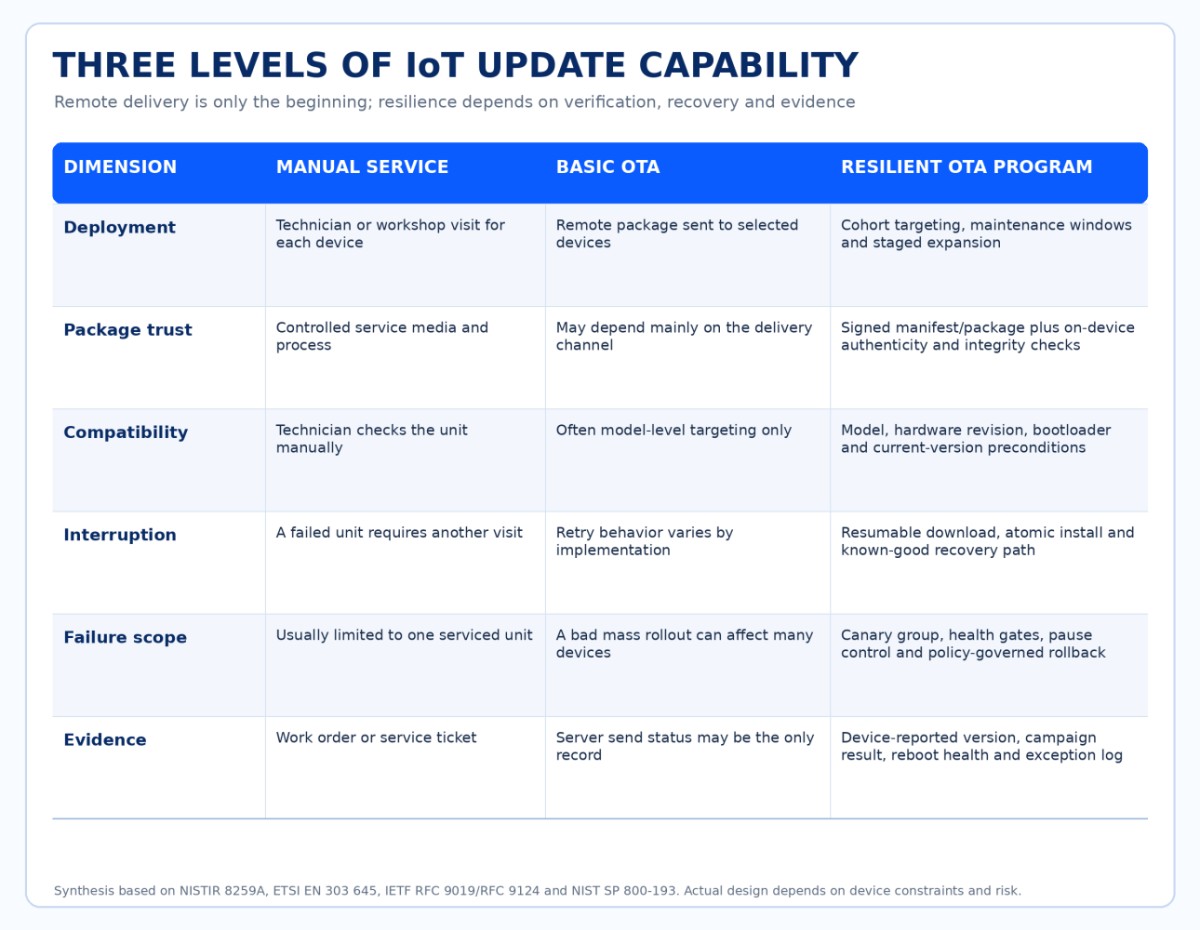
Manual Service, Basic OTA and Resilient OTA Are Not Equivalent
The comparison below summarizes typical capability levels. It is a procurement and architecture aid, not a claim that every implementation in a category behaves identically.
Figure 1. Typical differences between manual servicing, basic remote delivery and a resilient OTA program.
How Should OTA Work on Weak or Intermittent Networks?
The device should continue its essential function while the package is downloaded in the background, then install only when defined conditions are satisfied. If the device goes offline, it should retain a valid progress state or safely restart the download later. The working image should remain untouched until the candidate package has been completely received and verified.
Useful design choices include chunking, resumable transfer, integrity checks per object, randomized retry windows, bandwidth throttling, campaign scheduling by timezone or vehicle state, and a maximum retry policy. The correct combination depends on flash capacity, battery budget, network cost and the consequences of temporary downtime.
For high-mobility devices, connectivity quality can vary during one trip and across borders. Campaign planning should therefore distinguish “not yet reached,” “download incomplete,” “verification failed,” “installation deferred” and “post-install health failed.” Treating all five states as one generic failure makes remediation slower.
What Data Should an OTA Platform Record?
A useful minimum record for each device and campaign includes:
• device identifier, product model and customer or tenant assignment;
• hardware, bootloader, application and relevant modem/software-component versions;
• current configuration profile and compatible target release;
• campaign name, approval, package digest or manifest identifier and signing-key identity;
• download, verification, installation, reboot and health-check timestamps;
• final state, error reason, retry count and rollback or recovery result;
• last contact, power/network conditions and exception ownership; and
• support-period and end-of-life status for the product configuration.
Retention should be proportionate to operational, security and legal needs. Logs may contain device identifiers, account information, location-related context or other sensitive data, so access control and data minimization still apply.
A Buyer’s OTA Readiness Checklist
1. Define the update object. Is the supplier changing configuration, application firmware, modem software, certificates, AI models or all of these?
2. Confirm the eligible-device logic. Which model, hardware revision, bootloader, current version and customer variants can receive the release?
3. Ask how packages are authorized. Does the device verify authenticity and integrity independently of the transport channel?
4. Review key governance. Who can approve, sign and deploy production updates, and how can that authority be revoked or rotated?
5. Test interruption. What happens if the network drops, the vehicle loses power or storage fills during each phase?
6. Test recovery. Can the device boot a known-good image or enter a controlled recovery mode without a site visit?
7. Request staged rollout. Can campaigns use small cohorts, observation gates, scheduled windows, pause controls and exclusions?
8. Verify outcome evidence. Does success come from the device after reboot, or only from the server that sent the file?
9. Check bandwidth planning. What are package size, retry behavior, roaming implications and data-plan limits?
10. Confirm lifecycle ownership. How long will updates be supported, who monitors vulnerabilities and what happens at end of support?
Common OTA Misconceptions
“The download uses TLS, so the update is secure.”
TLS protects a communication session. It does not replace on-device verification that the package is authentic, intact, intended for this device and still authorized.
“A signed update cannot brick a device.”
A signature can establish origin and integrity, but correctly signed software can still contain a defect or be incompatible with one hardware revision. Recovery and staged rollout remain necessary.
“Rollback should always be allowed.”
Unrestricted downgrade can restore a known vulnerability. Recovery should return to an authorized known-good state under a controlled version policy.
“Every security update should be pushed to the whole fleet immediately.”
Critical fixes need urgency, but speed and control are not mutually exclusive. Pre-tested emergency cohorts, short observation gates and a prepared stop mechanism can reduce risk without creating unnecessary delay.
“OTA eliminates field service.”
OTA cannot repair damaged hardware, disconnected wiring, failed flash memory or a device that has lost every recovery path. It reduces avoidable visits; it does not make physical maintenance obsolete.
Engineering Perspective
Terry Wang emphasized: “The OTA loop is not complete when the server finishes sending. It is complete only after the device verifies the package, boots securely, runs a functional self-check and reports success.”
— Terry Wang, Senior IoT Engineer, WanWay Tech
This statement captures the operational boundary of OTA. Delivery, installation and recovery are different states, and the device—not only the campaign server—must supply the evidence that closes the loop.
Frequently Asked Questions
Q: What is the cost difference between OTA and manual updates?
A: For 10,000 devices, manual updates require 2,500+ labor-hours, while OTA requires planning approximately 50-55 GB of data traffic.
Q: How should a staged OTA rollout be configured?
A: A typical sequence is laboratory → 1% → 5% → 20% → 74%, with an observation gate at every stage.
Q: When does the EU Cyber Resilience Act apply?
A: CRA reporting obligations apply from 11 September 2026, while the main product obligations apply from 11 December 2027.
Q: What is the difference between OTA and FOTA?
A: OTA is the broad category of remote updates. FOTA usually refers specifically to firmware updates, while remote configuration, certificate replacement, content updates or AI-model updates may also travel over the air without replacing the complete firmware image.
Q: Why are OTA updates essential for IoT devices?
A: Because vulnerabilities, network dependencies, certificates, protocols and operating requirements change after deployment. Remote updating gives manufacturers a practical way to maintain large or geographically distributed device populations throughout their supported life.
Q: Can an IoT device update when it has no network connection?
A: It cannot receive a new remote package while fully offline. A resilient device should continue its essential function, preserve or safely restart download progress, and resume the update process when connectivity returns.
Q: Can OTA updates brick an IoT device?
A: Yes, a poor implementation or defective release can make a device unusable. Compatibility checks, safe power conditions, complete verification before installation, watchdogs, dual-bank or recovery images, staged rollout and pause controls reduce this risk.
Q: How do you secure an OTA firmware update?
A: Use protected signing keys, authenticated manifests or packages, on-device authenticity and integrity verification, device-specific compatibility checks, controlled version sequencing, secure boot where appropriate, restricted campaign authority, audit logs and tested recovery paths.
Q: Should IoT updates be automatic?
A: It depends on device risk, user control, operational criticality and local requirements. Automatic download with policy-controlled installation is often useful, but fleet operators may need maintenance windows, approvals or deferral controls. Urgent security fixes require a predefined escalation policy.
Q: How often should IoT firmware be updated?
A: There is no safe universal schedule. Updates should follow vulnerability severity, compatibility needs, defect impact and product policy. Manufacturers should continuously monitor relevant components and be able to issue a timely fix rather than waiting for an arbitrary annual release.
Q: What if an IoT device cannot support firmware updates?
A: The limitation and support period should be disclosed. The manufacturer and operator need a compensating plan such as isolation, restricted interfaces, hardware replacement or decommissioning when a serious vulnerability or incompatibility can no longer be corrected.
Q: Does OTA support prove that an IoT device is secure or CRA-compliant?
A: No. OTA is one lifecycle capability. Security and compliance also depend on product risk assessment, access control, data protection, vulnerability handling, documentation, support commitments, supply-chain roles and the exact implementation of the update mechanism.
Where WanWay Fits
WanWay develops cellular GPS tracking hardware, firmware and fleet-management solutions. Selected device models support OTA or FOTA functions and remote configuration, while IOPGPS supports centralized device operations. The relevant capability, update object and workflow depend on the exact model, hardware revision, firmware branch, platform arrangement and customer project.
For a deployment, the practical value is early coordination: fix the hardware/firmware baseline, define which settings may change remotely, test behavior under weak network and power interruption, plan compatible device cohorts and agree who owns updates throughout the support period. This is engineering groundwork, not a blanket claim that every product variant has the same OTA architecture or regulatory status.
Key Takeaways
• OTA is becoming a lifecycle necessity because security, connectivity and operational requirements change after shipment.
• A secure OTA system must verify, target, recover and report—not merely transfer a firmware file.
• Fleet-scale safety comes from version inventory, staged rollout, device-reported health and clear support ownership.
Next Step
Evaluating OTA-capable GPS tracking devices? Visit WanWay Tech to discuss the exact device and firmware configuration, or explore IOPGPS for fleet-management and integration options. Ask for a model-specific explanation of update scope, compatibility and recovery rather than relying on the word “OTA” alone.
EEAT: Author Experience and Technical Basis
This article was written by Terry Wang, Senior IoT Engineer at WanWay, who has 10 years of experience in GPS tracker R&D and FOTA implementation. WanWay provides 24/7 technical support. Official websites: wanwaytech.net | iopgps.com.
The analysis combines operational experience in cellular GPS devices, firmware maintenance and fleet device management with official IoT security and update guidance from NIST, ETSI, the IETF, the European Commission, CISA and Uptane. Sources were checked on 8 September 2026.
The quantitative examples in this article are transparent planning calculations, not claimed customer outcomes. Device behavior and OTA capability must be verified for the exact model, hardware revision, firmware branch, network environment and platform configuration.
This article is a technical overview, not legal advice or a certification statement. Standards and regulatory guidance can change; confirm the current official requirements and product-specific evidence before making procurement or compliance decisions.
References
1. NISTIR 8259A — IoT Device Cybersecurity Capability Core Baseline
2. NISTIR 8259 — Foundational Cybersecurity Activities for IoT Device Manufacturers
3. NIST — Technical IoT Device Cybersecurity Capabilities Catalog
4. NIST SP 800-193 — Platform Firmware Resiliency Guidelines
5. ETSI EN 303 645 V3.1.3 — Cyber Security for Consumer Internet of Things
6. IETF RFC 9019 — A Firmware Update Architecture for Internet of Things
7. IETF RFC 9124 — A Manifest Information Model for Firmware Updates in IoT Devices
8. European Commission — Cyber Resilience Act policy overview
10. Uptane Standard 2.1.0 — Secure software updates for ground vehicles
Author
Terry Wang, Senior IoT Engineer, WanWayTech
10 years of experience in GPS tracker R&D and FOTA implementation