

Table of Contents
- The Collier Trophy Confirms NRL’s Leadership
- Easton’s Early Contributions to Space Tracking
- From Vanguard to SPADATS: Building U.S. Space Surveillance
- The Birth of TIMATION: Synchronized Clocks in Orbit
- How GPS Was Really Formed: The 1973 Labor Day Conference
- NTS Satellites: Validating Atomic Clocks and Relativity in Space
- The Scientific Core of GPS: Passive Ranging + Atomic Time
- Conclusion: It’s Time to Recognize the Real Inventor of GPS
The Collier Trophy Confirms NRL’s Leadership
On May 4, 1993, the National Aeronautic Association awarded the prestigious 1992 Collier Trophy to the GPS Team for “the most significant development for safe and efficient navigation and surveillance of air and spacecraft since the introduction of radio navigation fifty years ago.” Of the five organizations honored, only three were instrumental during GPS’s foundational phase: the U.S. Air Force, the Aerospace Corporation, and—most critically—the U.S. Naval Research Laboratory (NRL).
Admiral Stan Arthur, then Vice Chief of Naval Operations, accepted the award on behalf of NRL and explicitly credited Roger L. Easton as the man who “fathered” GPS. This wasn’t ceremonial praise—it reflected historical fact. Two of Easton’s patents formed the bedrock of GPS’s passive ranging and time synchronization mechanisms. Moreover, every major architectural decision in today’s GPS system traces back to NRL’s TIMATION concept, not the Air Force’s competing 621-B proposal.
TL;DR: The Collier Trophy officially recognized NRL—and Roger Easton—as the intellectual origin of GPS.
Easton’s Early Contributions to Space Tracking
Roger Easton joined the Naval Research Laboratory in 1943 as a physicist. By 1955, he was already shaping America’s satellite strategy. His co-authored document, “A Scientific Satellite Program” (April 13, 1955), proposed using orbiting platforms not just for communication, but for geodetic measurement—including determining absolute latitude, longitude, and height from space-based observations.
This vision led directly to the MINITRACK system, designed to track satellites broadcasting known-frequency signals. Easton played a pivotal role in designing Vanguard I, launched on March 17, 1958—the oldest human-made object still in Earth orbit. Data from Vanguard I and its successors revealed that Earth is slightly pear-shaped, revolutionizing geodesy.
TL;DR: Easton’s early work on MINITRACK and Vanguard laid the groundwork for orbital tracking and Earth science.
From Vanguard to SPADATS: Building U.S. Space Surveillance
When the Soviet Union launched Sputnik on October 4, 1957, the U.S. had no system to detect unannounced satellites. Roger Easton swiftly proposed extending MINITRACK to track non-cooperative objects—those not broadcasting signals. The Advanced Research Projects Agency (ARPA) approved his plan, and in 1958, Easton became head of NRL’s new Space Applications Branch.
Under his leadership, the U.S. Navy Space Surveillance System (later part of SPADATS) was built. Achieving initial operational capability by 1960 and full status by 1966, it became the first system capable of detecting, tracking, and cataloging all Earth-orbiting objects—military, scientific, or debris.
In 1960, Easton received the Navy Distinguished Civilian Service Award, with the citation noting his “exceptional leadership and scientific ingenuity” in creating this system. Today, SPADATS tracks nearly 5,000 objects daily and has cataloged over 15,000 in its lifetime.
TL;DR: Easton invented America’s first space surveillance network—decades before modern space domain awareness.
The Birth of TIMATION: Synchronized Clocks in Orbit
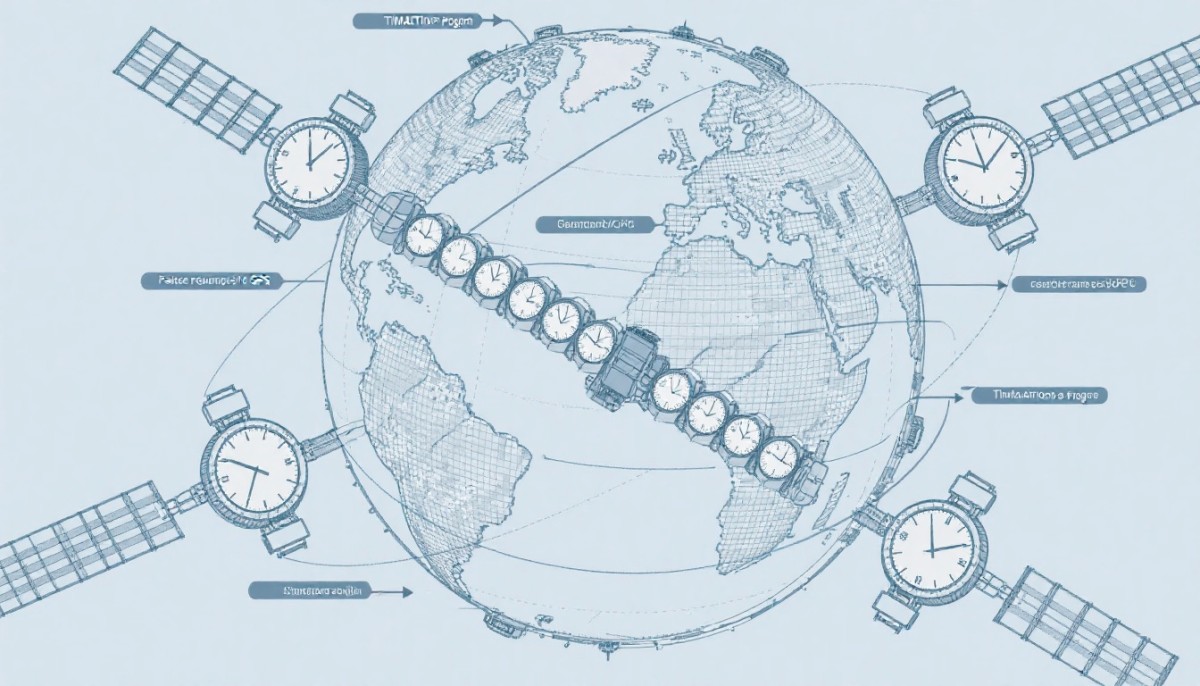
The conceptual leap to GPS emerged from Easton’s 1963 experiments enhancing the Navy Space Surveillance System. He realized that if satellites carried precisely synchronized clocks, users on Earth could calculate position by measuring signal travel time—without transmitting anything back (passive ranging).
This became the TIMATION (Time Navigation) program. Launched in 1967 and 1969, TIMATION I and II proved that synchronized quartz clocks in medium Earth orbit could enable global navigation. Crucially, TIMATION introduced the mid-altitude constellation (now standard in GPS) and the principle of one-way time transfer.
TL;DR: TIMATION established the core GPS principles: synchronized satellite clocks, passive ranging, and mid-orbit architecture.
How GPS Was Really Formed: The 1973 Labor Day Conference
In April 1973, Deputy Secretary of Defense William Clements initiated the Defense Navigation Satellite Development Program (DNSDP), initially favoring the Air Force’s 621-B geosynchronous design. But a Naval Weapons Laboratory report exposed critical flaws: orbital instability and poor coverage.
At the pivotal Labor Day Conference in 1973, the Department of Defense abandoned 621-B. Instead, it adopted NRL’s TIMATION architecture—including its clock technology, signal structure, and orbital configuration. This decision cemented Easton’s vision as the foundation of what we now call Navstar GPS.
TL;DR: GPS as we know it exists because the DoD chose NRL’s TIMATION over the Air Force’s flawed alternative.
NTS Satellites: Validating Atomic Clocks and Relativity in Space
After the GPS Joint Program Office formed in 1973, NRL built two Navigation Technology Satellites (NTS) to validate key technologies:
- NTS-1 (1974): First to fly a rubidium atomic clock in space.
- NTS-2 (1977): Carried a cesium atomic clock, broadcast the first GPS spread-spectrum signal, and included an NRL-built relativistic synthesizer to correct for Einstein’s time-dilation effects—ensuring GPS time matched Coordinated Universal Time (UTC).
These missions confirmed:
- Atomic clocks function reliably in orbit
- Relativistic corrections are essential
- Solar cell longevity and radiation hardening are feasible
- Laser retroreflectors enable precise orbit determination
NTS-2 alone validated the entire GPS error budget and proved worldwide time transfer.
TL;DR: NTS satellites de-risked GPS by proving atomic clocks, relativity, and signal design in real space conditions.
The Scientific Core of GPS: Passive Ranging + Atomic Time
Modern GPS delivers instantaneous 3D position, velocity, and time (PVT) because of Easton’s insight: combine four or more passive ranging measurements with ultra-stable atomic clocks. Since satellite clocks are syntonized (frequency-aligned), Doppler shifts yield 3D velocity in real time.
Even attitude determination—knowing which way a vehicle is pointing—is possible using antenna arrays, a direct descendant of Easton’s interferometer techniques from the Space Surveillance System.
TL;DR: GPS isn’t just about satellites—it’s about turning nanosecond-precise time into global positioning.
Conclusion: It’s Time to Recognize the Real Inventor of GPS
Roger L. Easton is the principal inventor of two operational DoD systems: the Navy Space Surveillance System and the Global Positioning System. While GPS has transformed civilian life—from smartphones to agriculture to disaster response—its origins remain under-credited.
Historical records, patents, satellite missions, and the Collier Trophy citation all point to one truth: GPS was born at the Naval Research Laboratory, conceived by Roger Easton.
As we enter an era of multi-constellation GNSS and quantum timing, honoring Easton isn’t just about history—it’s about recognizing how fundamental science, driven by visionary engineers, reshapes the world.
TL;DR: Roger Easton deserves global recognition as the true inventor of GPS—history, patents, and hardware prove it.